Get Paid To Promote, Get Paid To Popup, Get Paid Display Banner Banking POLITICAL WORLD

Tuesday, June 5, 2012

A Financial Story IPE Folks Should Love

Because it reinforces our priors:
Its membership in the euro currency union hanging in the balance, Greece continues to receive billions of euros in emergency assistance from a so-called troika of lenders overseeing its bailout.

But almost none of the money is going to the Greek government to pay for vital public services. Instead, it is flowing directly back into the troika’s pockets. ...
If that seems to make little sense economically, it has a certain logic in the politics of euro-finance. After all, the money dispensed by the troika — the European Central Bank, the International Monetary Fund and the European Commission — comes from European taxpayers, many of whom are increasingly wary of the political disarray that has afflicted Athens and clouded the future of the euro zone.
More here. I have said for awhile now that the story in the eurozone is that the north would keep the south liquid until the north's banks were sufficiently capitalized to handle a default, at which point the money would stop flowing. I thought that would be sometime in 2013 (I think I wrote a post saying that, but can't find it now), but now I think it could be this year.

Why should IPE folks like this story? Because this is the type of tale we tell all the time: "bailout" funds are used to bail out the donor, not the recipient. Just like "aid" funds to the developing world are often tied to certain types of disbursement and are thus a form of subsidy for corporations in the developed world.

There are parallels here (of course) to the Latin American debt crises of the 1980s, where much of the debt was owed to commercial banks in the U.S. The U.S. Treasury pushed for IMF intervention, mostly so U.S. banks could get their money back without the federal government having to officially bail them out. (The story is even more nuanced -- Congress understood what was happening and demanded new regulations of the banking sector, which led to the creation of the first Basel accord -- as Thomas argues here.)

Monday, June 4, 2012

Annals of Silly(?) Policymaking: Procyclical Financial Regulations During a Bank Run Edition

This (via @dandrezer) does not seem smart:
Banks must raise their core tier one capital ratios to 9pc by the end of this month or face the risk of partial nationalisation. The global Basel III rules are also pressuring banks to retrench.  
The International Monetary Fund said banks will have to slash their balance sheets by $2 trillion (£1.6 trillion) by the end of next year even in a "best-case scenario".
That is only within the European Union, and it came about due to panic over Greece last month. Basically, this means that EU banks have to increase their capital cushions by over 200% by the end of this month. What does that mean?
The Bank for International Settlements (BIS) said cross-border loans fell by $799bn (£520bn) in the fourth quarter of 2011, led by a broad retreat from Italy, Spain and the eurozone periphery.
Note that this just in Europe. But it made me wonder (on Twitter): why do this now? After all, it was Germany that insisted on a longer phase-in period for Basel III during negotiations, while the US/UK/Switzerland wanted that stricter capital requirements. Now the EU is doing a rapid phase-in and tougher capital limits years before they are required to by Basel. And they're doing it in the middle of a bank run during a continent-wide recession. What gives? A few things.

1. Banks do have to get to 9% tier 1 capital by the end of the month, but they don't have to come fully into compliance yet. That is, a lot of junk capital that is prohibited by Basel III -- but was allowed under Basels I and II -- will still be allowed. (ht to @Procyclicality for this point)

2. Nevertheless, this is still a big boost to minimum capital standards. So how will banks come into compliance? Two quick and easy ways are to:

a. Hold more cash.

b. Buy more sovereign debt.

The first of these is contractionary -- it's basically hoarding more cash rather than lending it out -- although the ECB can facilitate it if they want to pump eurozone banks full of cash. Non-euro EU central banks, such as the Bank of England, can do the same thing if they want and the US Federal Reserve has injected a bunch of liquidity into foreign banks when needed in the past as well. As a zero-risk instrument, cash has a zero risk weight, so adding more of it to your portfolio brings your overall capital ratio up.

The second of these is expansionary. OECD sovereign debt also carries a zero risk weight under Basel III, as it did under Basels I and II. This might seem bizarre at first, but remember who's making these rules: OECD governments. And OECD governments want to pay low interest on their debt. To do that, they rig the regulatory rules to make it more attractive for financial institutions to buy that debt. Hence, a zero risk weight in Basel.

So what does that mean? If banks need to boost their capital stock, there are two ways to do it: by raising more capital (e.g. by selling equity) or by shifting their risk portfolio. The former latter will be often preferred to the latter former, so banks are essentially being encouraged to buy sovereign debt (and other zero risk weight instruments) in order to come into regulatory compliance.

Was this the point of this policy? I don't know. Probably it was mostly a freak-out after runs started on Greece and then Spain. But I imagine it was part of the calculus, or at least has become so since. In practice this will likely be a transfer of private funding for public funding. Given that the ECB cannot provide liquidity directly to eurozone governments, but can accept sovereign debt as collateral when lending to banks, this could be part of a stealth bailout program that began when Mario Draghi took over as ECB chief from Jean-Claude Trichet last year. Call it "bailout by regulatory arbitrage".

Will it work? I don't know.

Tuesday, May 29, 2012

Democracy and Development

Xavier Marquez has a very interesting series of posts on the relationship between democracy and economic growth since the end of WWII:
The basics of this relationship in the post-WWII era seem pretty well understood: basically, the richer the country, the more “democratic” it appears to be (in the sense I’ve discussed here and here, where democracy is conceived as a system of normatively regulated competition for control of states including the usual paraphernalia of elections, freedoms of speech and assembly, etc.), though the reasons for why this is the case remain disputed, and there are obvious and significant exceptions to this pattern. Conversely, the academic literature suggests that democratic regimes have a slight and indirect long-term development advantage, though the evidence for this claim is much more controversial, and there is no consensus on how this particular advantage operates, if it exists at all
There are links to literature describing all of these assertions in the original post. Marquez then runs down some simple data (and presents it very well) and notes:
The median income of democratic regimes has been higher than the median income of both hybrid and fully authoritarian regimes since at least the 1950s, and the gap has in general widened, not narrowed, even as the number of democratic countries has increased. (From this graph we cannot tell, however, whether the gap has widened because democratic countries have grown faster, or because non-democratic countries that grew fast turned into democracies; from the graphs below, we may infer that it was a mixture of both). The gap was highest during “peak authoritarianism” in the late 1970s and early 1980s, when most poor and newly independent countries were either hybrid regimes or dictatorships, but it stopped growing after the end of the cold war, when a number of relatively poor countries became democratic. ...
What about growth? Is any particular regime type consistently associated with economic growth? ...
The answer is "not really" or at least "not very much". Dictatorships and hybrid regimes have more variability -- some grow very quickly, at least for awhile, but also go bust more frequently -- but averaging across regime types shows very little difference in central tendency:
To the extent that we can ignore these confidence intervals and focus only on the trend performance, democracies have not always done better than these other regimes. In the early post-war era it seems that dictatorships did better (though most did about as well as democracies), but then decolonization came along and the growth performance of dictatorships basically cratered. Indeed, the 80s, when the so-called “third wave” of democratization began, was also (not coincidentally perhaps?) the time when the “growth gap” between democracies and hybrid and dictatorial regimes was at its widest. Ominously, the last decade has seen a reversal of this pattern, which explains much of the (not very well thought out) commentary about the rise of the “Chinese model.”
He has a very cool motion chart at his blog (that I can't find the embed code for) that maps out the null effect, so click through to watch it.

Monday, May 28, 2012

More on Cowen on Europe

In his op-ed, Tyler Cowen raises a concern about a euro-collapse that I haven't much seen previously:
We thus face the danger that the euro, the world’s No. 2 reserve currency, could implode. Such an event wouldn’t be just another depreciation or collapse of a currency peg; instead, it would mean that one of the world’s major economic units doesn’t work as currently constituted.
There are a lot of claims -- some implicit -- in here. I'll take them in turn.

1. Does an exit of several peripheral countries from the eurozone constitue an implosion of a reserve currency? I don't think so. The status of the euro as a reserve currency does not depend on Greece's membership, it depends on Germany's management of it. If the alternatives are to jettison Greece -- or even several of the GIPSIs -- or to devalue the currency to keep them in, the euro's status as a reserve currency might actually be improved by a smaller membership of weak countries.

2. How important is the euro as a reserve currency? Roughly as important as the German mark was pre-euro, perhaps in combination with the the franc. The euro has not advanced much above the mark+franc status as a global reserve currency, if any at all, since its introduction in 1999. So the global economy as a whole does not appear to be very dependent on the euro; it is dependent on the US and, to a lesser extent, Germany, Britain, and Japan.

3. Would a euro-exit be more severe than a collapse of a currency peg? It conceivably could, but again: what matters most is Germany, and markets' belief in Germany's credibility to maintain a valuable currency. Germany's economy is not on the verge of collapse, nor does it depend on Greece, and German policymakers have repeatedly chosen to maintain policy credibility over possibly saving peripheral members. How much do markets care about Greece? I'll return to that below.

4. Would a euro-exit signal that one of the world's major economic units doesn't work? No. Greece is not one of the world's major economic units. A euro-exit would signal that one of the world's major political units doesn't work, but I'm not sure that this is new information nor am I sure that markets care all that much. The the extent that markets prefer stability over instability any resolution may be preferable to continued uncertainty.

Let's look at some data. Has the euro has significantly weakened as the crisis has grown more severe?


A bit. But if we zoom out and look at a longer time series we see that the euro is now trading at historical levels:


If Greece leaves will the value of the euro hold? Considering that Greece is by far its weakest link I would think so. Indeed, the fewer non-German members in the euro the more credibility it has! Germany does not need to devalue.

Anyway, just how important is the euro? At the end of last year global dollar holdings were nearly 250% higher than euro holdings. Or consider the exchange market. The introduction of the euro did nothing to reduce the world's reliance on the dollar, as I discuss (and graph) here. The euro is used in roughly the same percentage of the world's Forex as was the mark + franc. The global economy survived the end of those currencies.

There is only one truly important global currency -- the dollar.

Perhaps most distressingly, Cowen seemingly misunderstands the arguments of Kindleberger that he references in the paragraph immediately following the quoted one above:
We are realizing just how much international economic order depends on the role of a dominant country — sometimes known as a hegemon — that sets clear rules and accepts some responsibility for the consequences. For historical reasons, Germany isn’t up to playing the role formerly held by Britain and, to some extent, still held today by the United States. (But when it comes to the euro zone, the United States is on the sidelines.)
I said a bit about that in my post yesterday, and I'll say more about it in another post (this is plenty long already), but if the hegemon is most important than we should really only be concerned about the US (the global hegemon) and Germany (the regional hegemon), not Europe's southern periphery. And the role of the hegemon is to stabilize the system, not necessarily to guarantee good outcomes for every constituent within it.

Think about it this way: if Germany left the euro and re-issued the mark, do you think it would be stronger or weaker than the Germany-less euro? Do you think the new mark would be used more as a reserve currency than the euro or less?

So why should we think that a Greek exit would be much worse than "another depreciation or collapse of a currency peg"?

Sunday, May 27, 2012

The World's Central Banker, Yet Again

Tyler Cowen summons his inner Kindleberger and gets pessimistic:
We are realizing just how much international economic order depends on the role of a dominant country — sometimes known as a hegemon — that sets clear rules and accepts some responsibility for the consequences. For historical reasons, Germany isn’t up to playing the role formerly held by Britain and, to some extent, still held today by the United States. (But when it comes to the euro zone, the United States is on the sidelines.)
It depends on what he means by "on the sidelines". The US Congress is certainly not doing anything about Europe. Short of a Marshall Plan for the GIPSIs I'm not sure what they could do, and there's no way that's happening. But that doesn't mean that the US government as a whole is showing no hegemonic leadership. I've written a number of posts arguing that Bernanke has been acting as the world's central banker during the crisis -- opening swap lines with every major central bank in the world, extending liquidity financing to foreign firms, not provoking currency wars that lead to competitive devaluations, etc. -- and that this has stabilized the core of the global financial system.

I'm not going to re-write all those posts here, but please click through and read them. The Fed has been engaged in hegemonic leadership, and has done pretty well so far. Its job is not to put out every fire everywhere; its job is to keep the center of the system intact. So far, at least, its actions have been sufficient.

Note that in the op-ed Cowen more than once sounds a lot like an IPE scholar who has read no IPE literature. That is, he's asking the right questions but fumbles for answers to them. I have other things to write about the piece, but I'm going to break them up into pieces over the next day or two. Consider this a teaser.

Friday, May 25, 2012

When Did the Dollar Become the World's Reserve Currency?

New research from Livia Chitu, Barry Eichengreen, Arnaud J. Mehl. The abstract:
This paper offers new evidence on the emergence of the dollar as the leading international currency, focusing on its role as currency of denomination in global bond markets. We show that the dollar overtook sterling much earlier than commonly supposed, as early as in 1929. Financial market development appears to have been the main factor helping the dollar to surmount sterling’s head start. The finding that a shift from a unipolar to a multipolar international monetary and financial system has happened before suggests that it can happen again. That the shift occurred earlier than commonly believed suggests that the advantages of incumbency are not all they are cracked up to be. And that financial deepening was a key determinant of the dollar’s emergence points to the challenges facing currencies aspiring to international status.
I haven't read it yet, but I'm predisposed to disagree with the conclusion.

Thursday, May 24, 2012

Asymmetry in Global Markets

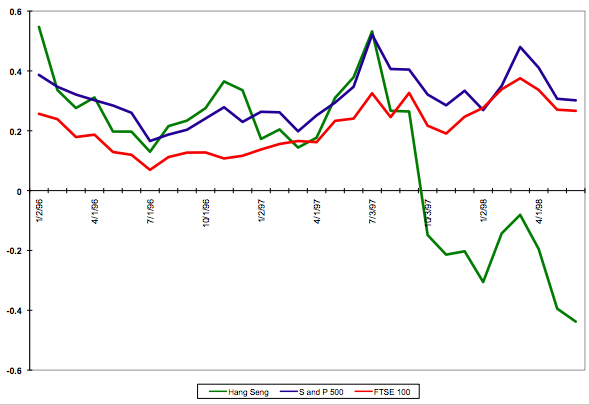
Some argue that we understate the significance of the Asian crisis. So, here are three graphs of equity market correlations in moments of rather severe crisis. The unit in each is 12 month percent change.

1. Black Monday, October 1987. Biggest Single Day Correction in US History. Notice that the FTSE and Hang Seng follow the US down. Notice the correlation 10 years prior to the 1997 Asian crisis.

2. The Asian Crisis, 1997. Notice the separation. Hong Kong falls sharply. The US and UK give back a few gains but then recover very quickly. No banks failed in the US as a result of this crisis. And I note that this Asian crisis was probably the most severe to occur prior to 2008. And yet


3. US Subprime, 2007-09. The rest of the world follows the US down.

So, is Greece more like Thailand, or is Greece more like the United States? We think Greece is more like Thailand.