
Ask Americans if they are willing to spend more to buy American-made products, and nearly half say they are often willing to do this. But in the latest Economist/YouGov Poll, the country where a product is made trails price, quality, and even convenience, as an important factor in consumer decision-making. The public gives even less importance to a product’s brand, its impact on the environment, or the political leanings of the company that produces it.More.
Showing posts with label Rational Choice. Show all posts
Showing posts with label Rational Choice. Show all posts
Saturday, April 28, 2012
Score One for Materialists
Via MR:

Tuesday, July 12, 2011
OT: Does Yadier Molina Hurt the Cardinals By Being Awesome?
Note: While watching the All-Star game, I grabbed some data and wrote this post for Viva El Birdos, the best blog covering my favorite sports team, the St. Louis Cardinals. Since it's kinda-sorta rat choicey I thought I'd toss it up here too. Oh who am I kidding... I'm putting it here because I don't feel like writing another post tonight. If I thought hard enough I'm sure I could squeeze out some relevance for IPE, but I'm not going to bother. Skip it if you like.
It's generally accepted that in terms of preventing other teams from stealing bases Yadier Molina is one of the best, if not the best, catchers in MLB. Al Hrabosky is fond of saying that Yadi is so good that teams just don't steal on him anymore (and Al's not the only one). Which always made me wonder... Given that base-stealers must be successful at least 75% of the time to benefit their team, is it really a good thing if Yadi's excellence at throwing out stealers prevents teams from running? After all, if teams ran on him more, he'd generate more outs. Perhaps it would be better for the team is Yadi was worse, thus generating more attempts, thus generating more outs.
I had a few hours to kill tonight, so I thought I'd plot some data, all of which comes from Baseball Reference. The first graph shows the percentage of would-be stealers that Yadi has caught in his career, as well as the National League average.
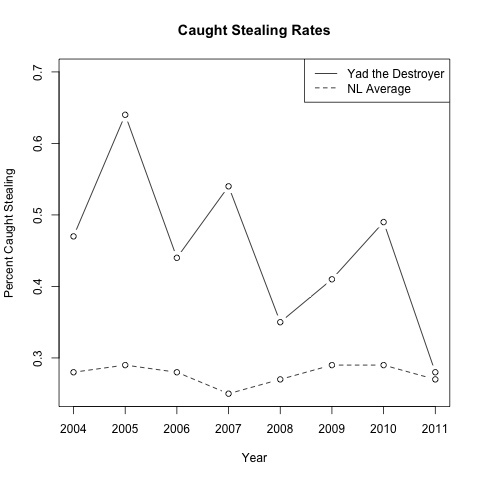
As expected, Yadi has been very good over the course of his career, well better than the league average, although so far this year has been his worst. But has his success had an effect on other teams? In other words, do teams run on Yadi much less than other catchers? This next graph shows the stolen attempts for Yadi (per 162 games) compared to the NL average. (Formulas: (SB+CS)*(162/GP) for Yadi; ((SB/G)+(CS/G))*162 for NL.)
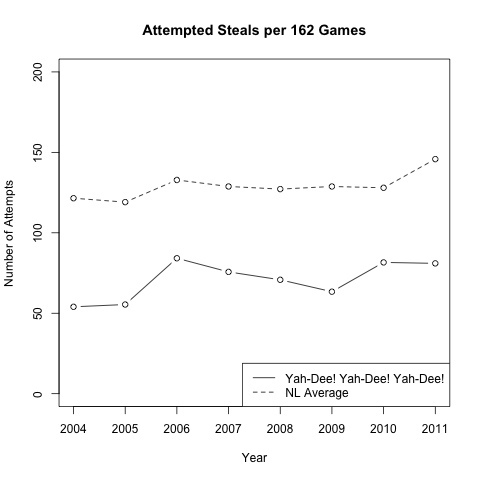
Okay, so teams really don't run on Yadi: he routinely has 50-60 fewer attempts against than the NL average catcher -- or would have, if he played all 162 games. So Yadi has fewer attempts against but more outs per attempt than the average catcher. We might think that the team would benefit if we could maximize the number of outs made (so long as the percentage of caught stealing remains above 25%). How does this translate into outs over the course of a season? (Formulas: CS*(162/GP) for Yadi; (CS/G)*162 for NL. Again this is normalized as if Yadi played in every game.)

The answer is... there's not a huge effect, but Yadi's prodigious ability to catch potential base stealers probably doesn't help the team, and might even hurt it a bit. In four years (2004, 2008, 2009, 2011), Yadi generated fewer outs on the bases than the NL average. In two years (2007, 2010), he generated more. In two years (2005, 2006), he generated almost exactly the same. In no year is the difference all that large. For the stats-minded: I doubt the effect is statistically significant, but in this case a failure to reject the null hypothesis is very interesting, since it contradicts the Hrabosky-esque conventional wisdom. Obviously this is a crude analysis, but often simple stats are the most illustrative.
The broader point that I'm interested in making is that baseball, like all games, is strategic. If a player is really, really good (or bad) at one thing, then other teams will respond by changing their approach to the game in order to neutralize that advantage. Think of NBA teams fouling Shaq intentionally to make him shoot free throws. Or MLB teams walking Barry Bonds 232 times (!) in 2004. In some cases, it might benefit the team if the individual player were a little bit worse, so that their opponents didn't focus so much attention on them.
In other words, Yadi probably hasn't hurt the team with his cannon arm, at least not much. But he hasn't helped the team much either. It would probably be better for the team if he was slightly above average (say, 30-35% caught-stealing rate rather than 40-50%) but not enough for teams to drastically alter their base-running patterns.
Friday, December 10, 2010
The "I'd Gladly Pay You Tuesday For a Hamburger Today" Theory of Economics
Munger took some time before getting his eyes lasered today to say this:
To have an effect on economic activity, tax cuts have to be credibly permanent.
The assumption here is that people will recognize that present tax cuts will be offset by future tax increases, so unfunded tax cuts will have no effect on behavior: people will just sit on the money until they have to pay it back. And that's true if people are atomistic Friedmanite permanent-income-smoothing fully-forward-looking individuals with complete and perfect information about their future incomes. We know this from theory that is deduced from those assumptions, and if those assumptions hold, then the conclusions also hold.
But the assumptions of theory do not necessarily hold. All of those descriptors above are wrong or at least (I'm being very generous) probabilistic rather than certain, so the question becomes empirical, not theoretical. And the empirical record, as far as I can tell, is completely bollocks-upped.
I can easily imagine a situation in which someone offers to give me money today, on the condition that I have to pay it back tomorrow, and I nevertheless alter my behavior and spend it rather than save it. That's how credit -- the foundation of the capitalist economy -- works. Mastercard does not have to credibly promise me a free $500 that I will never have to pay back in order for me to spend. They only have to promise me $500 today. If I think spending $500 today is worth paying back $525 tomorrow -- say, because I'm unemployed, or my house is at risk of foreclosure, or I just got furloughed at work, or... -- then I just might do it.
Example: the cash-for-clunkers program is routinely criticized for doing nothing more than pulling future spending into the present. But that was the whole point. And it worked! There were a lot of car purchases during that window that would have been spread out otherwise. (IIRC, Munger took advantage of this himself, but I can't find the post now so it could have been someone else in my RSS.) Of course people with clunkers would eventually buy a new car, but the government decided that they wanted them to buy a car today, not tomorrow. As it happens I think that was a poor choice of priorities, as I think most (not all) of this grand Obama/GOP bargain to be a poor choice of priorities, but the problem wasn't that cash for clunkers didn't work; the problem was that it was a silly and expensive tradeoff.
This is something that has always confused me about rational expectations econ, but then my econ education ended in undergrad. I can't even pretend to have a great grasp on the advanced literature, so possibly all these objections are easily overcome. If so, I'm sure someone will set me straight.
UPDATE: I've been grading finals all day (All Done!) so I didn't see Angus' relevant reply until just now. Angus believes in rational expectations, PLUS seems to have a zero percent discount rate, and still finds (to his apparent surprise) that he himself doesn't act as if these were his true beliefs. People, doesn't this tell you all you need to know? If a true believer rat expectations doesn't act like he should, who will? Yikes!
UPDATE 2: I'm still catching up on my RSS, and now I see Munger wrote a follow-up post in which he describes a scenario in which a car dealer offers a customer a loan, to be repaid with interest, if the customer is willing to purchase a car today rather than after he has saved up enough to pay the full sticker price in cash. Munger views this scenario as absurd. I view this scenario as basically the single most typical durable goods transaction in the world. One of us has to be wrong.
Subscribe to:
Posts (Atom)